
In today’s hyper-connected global market, a company is only as strong as its most fragile supplier. From unexpected material shortages to sudden quality drops that halt production, supply chain vulnerabilities are a primary threat to operational stability and brand reputation.
To combat this, leading organizations are shifting away from price-only procurement models and mandating a universal standard of quality: ISO 9001 certification. Requiring your suppliers to achieve this internationally recognized Quality Management System (QMS) standard is no longer just a “nice-to-have”; it is a critical strategy for risk mitigation, cost control, and sustainable growth.
Here is why your organization should consider making ISO 9001 a non-negotiable prerequisite for your supply chain.
1. Guaranteeing a Standardized Language of Quality
When your suppliers are ISO 9001 certified, you establish a unified operational language. The standard mandates that organizations build their processes around the Plan-Do-Check-Act (PDCA) cycle.
By requiring this framework, you ensure that a supplier’s quality is not reliant on “tribal knowledge” or a few star employees, but is embedded into their daily operational architecture.
- Predictability: You can expect the same high-quality components in year three as you received on day one.
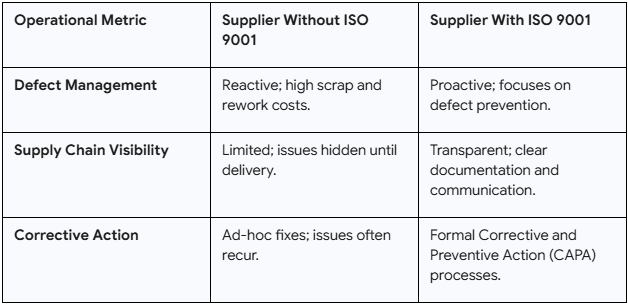
- Traceability: If a defect does occur, documented processes make it vastly easier to trace the root cause and isolate the impacted batch.
2. Radical Risk Mitigation
Uncertified suppliers often operate reactively, putting out fires as they happen. ISO 9001 requires a proactive approach through “risk-based thinking.” Suppliers must systematically identify potential risks—from equipment failure to labor shortages—and implement preventative measures before they impact the customer.
3. Slashing Supplier Auditing Costs
Vetting and auditing suppliers consumes significant time, money, and manpower. While requiring ISO 9001 does not entirely eliminate the need for your own due diligence, it serves as a powerful pre-qualification filter.
Because an independent, third-party registrar, such as ISO Certifications Group has already audited the supplier’s QMS to verify compliance, your procurement and quality teams can skip the foundational checks. Instead of spending days verifying basic document control or calibration records, your auditors can focus on strategic, product-specific evaluations.
4. Fostering a Culture of Continuous Improvement
Perhaps the most valuable aspect of ISO 9001 is that it is not a static achievement. Certified organizations must continually audit themselves and demonstrate continuous improvement to maintain their certification.
When you require this of your supply chain, you are inherently partnering with vendors who are systematically looking for ways to become faster, leaner, and more reliable. As they refine their processes and reduce their own waste, those efficiencies often translate into better pricing, faster lead times, and enhanced innovation for your organization.
About The Author
Oscar Combs is the President of ISO Certifications Group, a certification body headquartered in Houston, Texas. With over 31 years of experience in the field, he is recognized as an expert in management systems that help organizations manage risk and improve operational efficiency.
ISO Certifications Group
ISO Certifications Group is an accredited ISO certification body that certifies ISO 9001, ISO 14001, ISO 45001, and ISO 50001 Management Systems for organizations. Contact us at info@isocertificationsgroup.com for more information or www.isocertificationsgroup.com.