
The International Organization for Standardization (ISO) has published over 25,000 standards, but a select few dominate the global business landscape. Based on the most recent ISO Survey data (which tracks the number of active certificates worldwide), three standards consistently top the list.
These “Big Three” are popular not just because they are often contractually required, but because they form the baseline for operational excellence in quality, environment, and safety.
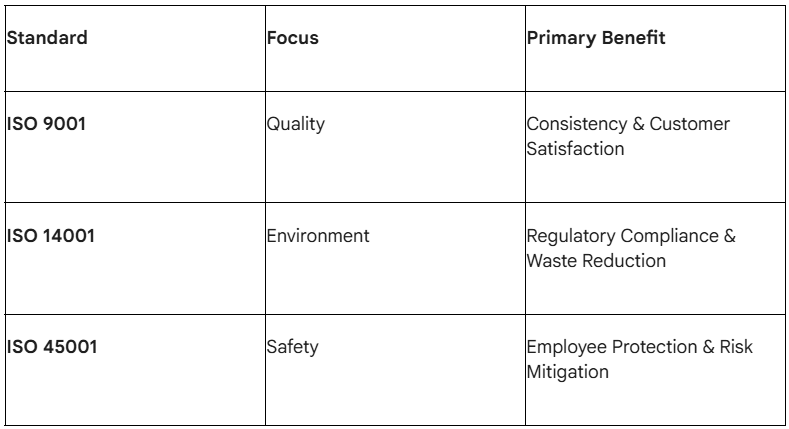
1. ISO 9001: Quality Management Systems (QMS)
The undisputed king of standards.
With over 800,000 certificates globally, ISO 9001 is by far the most widely adopted standard in the world. It is “industry agnostic,” meaning it is used by everyone from massive aerospace manufacturers to small local coffee roasteries.
Why It Is Popular
- The “License to Trade”: In many supply chains (especially automotive, aerospace, and government contracting), ISO 9001 is a mandatory prerequisite. You simply cannot bid on the contract without it.
- Operational Consistency: It forces organizations to document their processes. If a key employee leaves, the business doesn’t collapse because the “how-to” is standardized, not just stored in someone’s head.
- Customer Confidence: The ISO 9001 stamp signals to buyers that the company has a verified system for fixing errors and ensuring customer satisfaction.
Key Stat: ISO 9001 typically holds more certificates than all other management standards combined.
2. ISO 14001: Environmental Management Systems (EMS)
The standard for the green economy.
Ranking second with over 300,000 certificates, ISO 14001 helps organizations manage their environmental responsibilities. As climate change and sustainability become board-level priorities, this standard has shifted from “nice-to-have” to “essential.”
Why It Is Popular
- Supply Chain Pressure: Large corporations (like Apple, Toyota, or Walmart) often require their downstream suppliers to hold ISO 14001 to prove they aren’t introducing environmental risks into the supply chain.
- Cost Savings: It isn’t just about saving trees; it’s about saving money. The standard provides a framework to reduce waste, energy consumption, and raw material usage, which directly improves the bottom line.
- Regulatory Compliance: It provides a structured way to keep track of the thousands of environmental laws a company must follow, reducing the risk of massive government fines.
3. ISO 45001: Occupational Health and Safety (OH&S)
The fastest-growing major standard.
With approximately 185,000+ certificates, ISO 45001 has firmly secured the third spot. It replaced the old British standard OHSAS 18001 and has seen rapid adoption as companies prioritize employee welfare to reduce liability and improve morale.
Why It Is Popular
- Risk Reduction: It systematically identifies workplace hazards (from slippery floors to chemical exposure) before an accident happens.
- Lower Insurance Premiums: Many insurance providers offer better rates to organizations that can prove they have a certified system for managing safety risks.
- Legal Defense: In the event of a workplace accident, holding ISO 45001 certification serves as strong evidence of “due diligence,” proving the company took reasonable steps to protect its workers.
Summary
While other standards like ISO/IEC 27001 (Information Security) are growing explosively due to cyber threats, they still trail the “Big Three” in raw numbers. For most businesses, the journey to standardization starts with Quality (9001), expands to Environment (14001), and solidifies with Safety (45001).
About The Author
Oscar Combs is the President of ISO Certifications Group, a certification body headquartered in Houston, Texas. With over 31 years of experience in the field, he is recognized as an expert in management systems that help organizations manage risk and improve operational efficiency.
ISO Certifications Group
ISO Certifications Group is an accredited ISO certification body that certifies ISO 9001, ISO 14001, ISO 45001 and ISO 50001 Management Systems for organizations. Contact us at info@isocertificationsgroup.com for more information or www.isocertificationsgroup.com.