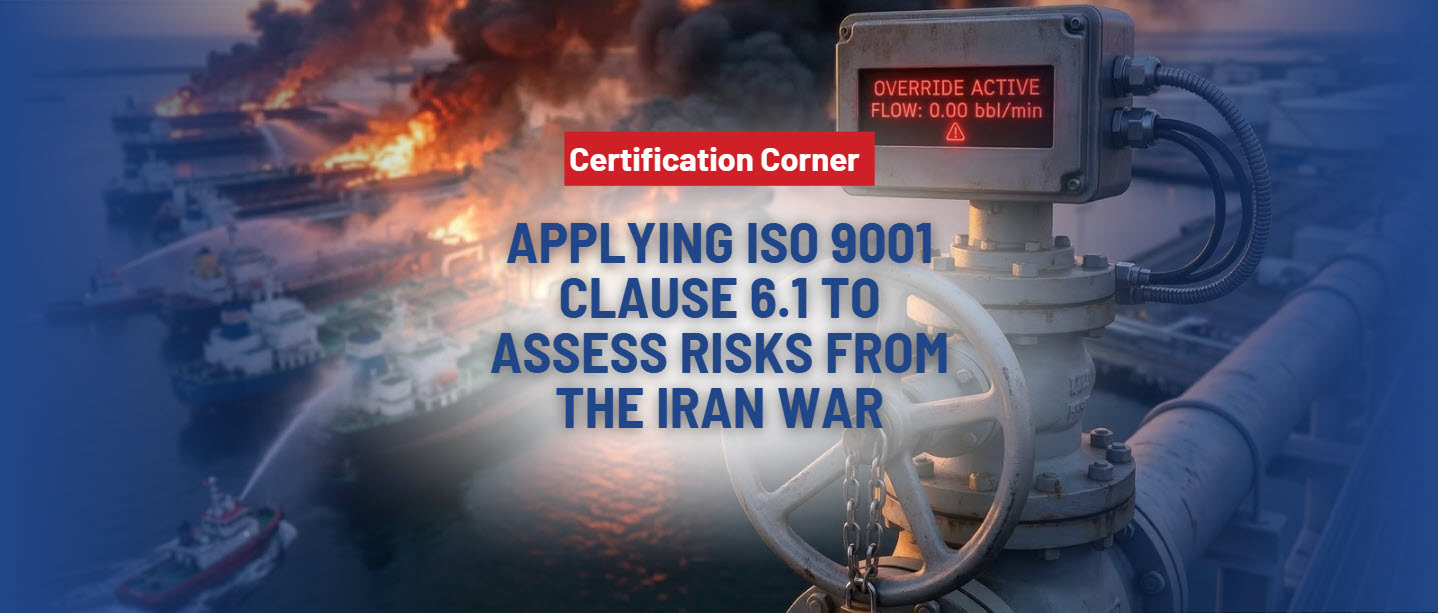
For United States businesses, geopolitical instability in the Middle East—particularly the war involving Iran—creates a complex web of operational, financial, and regulatory challenges. From supply chain bottlenecks to escalated cybersecurity threats, the ripple effects can severely impact an organization’s ability to deliver products and services consistently.
Fortunately, businesses operating under the ISO 9001 standard already possess a powerful framework for navigating this uncertainty: Clause 6.1 (Actions to address risks and opportunities). This clause mandates “risk-based thinking,” shifting risk management from a reactive checklist to a proactive, strategic process.
Here is how US businesses can utilize ISO 9001 Clause 6.1 to systematically assess and mitigate risks stemming from the Iran conflict.
Understanding the Foundation: Context is Everything
Before jumping into Clause 6.1, it is critical to look at its prerequisites. Clause 6.1 explicitly requires organizations to consider:
- Clause 4.1 (Context of the Organization): A war in the Middle East drastically alters an organization’s external context.
- Clause 4.2 (Needs and Expectations of Interested Parties): How does this conflict change what your customers, suppliers, and regulators need from you?
Risk-based thinking starts by acknowledging that a geopolitical conflict does not impact every business equally. A local software firm faces different risks (e.g., cyber warfare) than a global manufacturer reliant on petroleum-based raw materials.
A 5-Step Guide to Assessing Geopolitical Risk Under Clause 6.1
1. Identify the Specific Risks to Your Organization
Under 6.1.1, businesses must determine the risks needed to ensure the Quality Management System (QMS) can achieve its intended results. In the context of an Iran-related conflict, US businesses should immediately assess the following core areas:
- Supply Chain Disruption: Iran’s proximity to the Strait of Hormuz—a vital global shipping choke point—means maritime logistics are severely delayed or halted. Assess whether your tier-1 or tier-2 suppliers rely on this route.
- Energy Price Volatility: Conflicts in this region historically trigger spikes in oil and natural gas prices. This impacts freight, manufacturing costs, and the price of petroleum derivatives (plastics, chemicals).
- State-Sponsored Cyberattacks: US infrastructure and private businesses are prime targets for retaliatory cyber campaigns. Data breaches, ransomware, or distributed denial-of-service (DDoS) attacks can halt operations.
- Sanctions and Regulatory Compliance: The US government frequently expands economic sanctions during conflicts. Doing business, even indirectly, with embargoed entities poses severe legal risks.
2. Determine the Potential Impact and Likelihood
ISO 9001 requires that actions taken to address risks be proportionate to the potential impact on the conformity of products and services.
Create a risk matrix to evaluate each identified threat:
- Likelihood: How probable is this event? (e.g., A cyberattack might be highly likely, whereas a total embargo of a specific raw material might be moderately likely).
- Impact: If this happens, how badly does it affect your ability to serve your customers? (e.g., A 50% increase in shipping costs might hurt margins, but a supplier going out of business halts production entirely).
3. Plan Actions to Address the Risks
Once risks are prioritized, Clause 6.1.2 mandates that you plan actions to address them. This is where strategic mitigation comes into play. Example actions include:
- For Supply Chain Risks: Dual-sourcing raw materials from suppliers outside of affected regions (e.g., nearshoring to Mexico or domestic suppliers). Increasing buffer inventory for critical components.
- For Cyber Risks: Implementing zero-trust IT architecture, conducting employee anti-phishing training, and ensuring off-site, immutable backups are updated daily.
- For Energy Costs: Hedging fuel costs through financial contracts or shifting to more energy-efficient production schedules.
- For Compliance: Utilizing automated compliance software to screen all new and existing vendors against updated OFAC (Office of Foreign Assets Control) sanctions lists.
4. Integrate and Implement Actions into QMS Processes
A plan is useless if it sits in a binder. ISO 9001 requires these actions to be integrated into your actual QMS processes.
- Update your purchasing procedures to require vendor geographic risk assessments.
- Revise your IT security policies to reflect heightened threat levels.
- Adjust your pricing models or customer contracts to account for force majeure events or sudden freight surcharges.
5. Evaluate the Effectiveness of These Actions
The final requirement of Clause 6.1.2 is to evaluate whether your actions actually worked. Geopolitical situations are highly fluid. A risk assessment done in January might be obsolete by March.
Conduct tabletop exercises simulating a major cyberattack or a total loss of a key supplier to test your operational resilience.
Schedule frequent management reviews (Clause 9.3) focused specifically on supply chain and cybersecurity metrics.
The Goal: Resilience, Not Just Compliance
Using ISO 9001 Clause 6.1 to assess the risks of international conflicts isn’t just about passing your next surveillance audit; it is about building a resilient organization. By systematically identifying vulnerabilities and proactively planning mitigations, US businesses can protect their bottom line, ensure consistent delivery to their customers, and navigate global turbulence with confidence.
About The Author
Oscar Combs is the President of ISO Certifications Group, a certification body headquartered in Houston, Texas. With over 31 years of experience in the field, he is recognized as an expert in management systems that help organizations manage risk and improve operational efficiency.
ISO Certifications Group
ISO Certifications Group is an accredited ISO certification body that certifies ISO 9001, ISO 14001, ISO 45001 and ISO 50001 Management Systems for organizations. Contact us at info@isocertificationsgroup.com for more information or www.isocertificationsgroup.com.