As of early 2026, the trade relationship between the United States and Mexico has reached a historic zenith. Mexico has officially solidified its position as the largest trading partner of the United States, surpassing both Canada and China. This economic integration is underpinned by a shared commitment to quality management, yet a look at the ISO 9001 certification numbers reveals two very different industrial stories.
The Numbers at a Glance (2025/2026 Estimates)
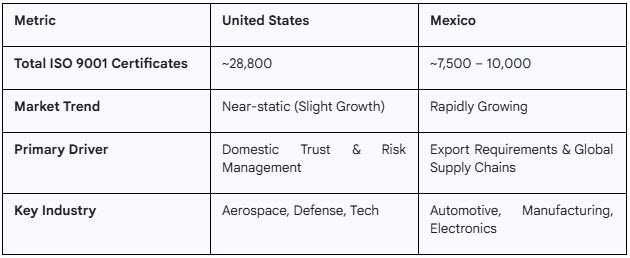
Data from the most recent ISO Surveys and trade reports indicate a stable but contrasting trend in how these North American neighbors utilize ISO 9001:
Mexico: The “Nearshoring” Quality Surge
In Mexico, ISO 9001 is increasingly seen as the entry ticket to the global stage. With the massive influx of “nearshoring”—companies moving manufacturing from Asia back to North America—Mexican firms are under pressure to harmonize their quality standards with international expectations.
- Manufacturing Dominance: Much of Mexico’s certification growth is concentrated in the “Maquiladora” sector and the automotive industry. For many Mexican suppliers, ISO 9001 is the baseline, often serving as a stepping stone to more rigorous standards like IATF 16949 (Automotive).
- Government Alignment: The Mexican government, through the General Direction of Standardization (DGN), has closely aligned national standards (NMX-CC) with ISO 9001 to ensure seamless trade under the USMCA.
The United States: A Mature, Stable Market
The U.S. holds a significantly higher total number of certifications, but the market is characterized by maturity rather than rapid expansion.
- The “Invisible Wall”: For over a decade, U.S. certifications have hovered around the 25,000–30,000 mark. Many American companies prioritize internal quality systems or industry-specific standards (like AS9100 for Aerospace) over a general ISO 9001 certificate.
- Strategic Risk Management: In the U.S., the 2026 transition is being driven by resilience. American firms are using ISO 9001 to manage complex, often volatile supply chains and to provide “evidence of due diligence” in an increasingly litigious and cyber-conscious market.
Why the Gap Matters for Trade
Despite the U.S. having nearly triple the number of certifications, the density of certification in Mexico’s export-oriented sectors is remarkably high. This ensures that the US$800+ billion in annual two-way trade moves through a “Quality Corridor” where both sides speak the same process language.
As we move toward the ISO 9001:2026 rollout, both nations are focusing on the same new requirements: Climate Change integration and Digital Evidence. For Mexico, this means proving environmental sustainability to US buyers; for the US, it means leveraging digital dashboards to monitor those Mexican suppliers in real-time.
About The Author
Oscar Combs is the President of ISO Certifications Group, a certification body headquartered in Houston, Texas. With over 31 years of experience in the field, he is recognized as an expert in management systems that help organizations manage risk and improve operational efficiency.
ISO Certifications Group
ISO Certifications Group is an accredited ISO certification body that certifies ISO 9001, ISO 14001, ISO 45001 and ISO 50001 Management Systems for organizations. Contact us at info@isocertificationsgroup.com for more information or www.isocertificationsgroup.com.
Watch our YouTube Video about this article.