

The recent National Transportation Safety Board (NTSB) report on the November 4, 2025, UPS Flight 2976 crash in Louisville, Kentucky, has sent shockwaves through the aviation industry.1 The investigation revealed that a critical engine mount component—the spherical bearing race—failed, causing the left engine to detach during takeoff.2
Most chillingly, this specific part had failed four times previously on other aircraft, a fact documented by Boeing as early as 2011.3 Despite these warnings, the manufacturer categorized the issue as a non-safety concern. This tragedy serves as a grim case study in how the rigorous application of ISO 9001:2015 principles—specifically risk-based thinking, nonconformity management, and root cause analysis—can be the difference between a routine maintenance update and a catastrophic loss of life.
1. Risk-Based Thinking (ISO 9001 Clause 6.1)
Risk-based thinking is the preventive backbone of modern quality management. It requires organizations to evaluate the probability of an event against its severity.
In this case, the severity of an engine detaching from a wing is inherently “Catastrophic.” Even if the probability was deemed low based on four failures over thousands of flight hours, ISO 9001 logic dictates that any risk with a catastrophic outcome must be mitigated, regardless of frequency.
- The Failure: The 2011 assessment labeled the part failure as a “non-safety of flight condition.”4
- The ISO Solution: A proper risk assessment would have recognized that the bearing race is a “single point of failure” for the engine mount. Risk-based thinking would have mandated an Airworthiness Directive (AD)—a mandatory fix—rather than a voluntary “service letter.”5
2. Managing Nonconformities (ISO 9001 Clause 10.2)
Under ISO 9001, a nonconformity is any failure to meet a requirement.6 When a part fails four times across three different aircraft, it is no longer an “isolated incident”; it is a systemic nonconformity.
- The Failure: The industry treated the four prior failures as individual maintenance events rather than a pattern of systemic instability.
- The ISO Solution: Clause 10.2 requires organizations to “evaluate the need for action to eliminate the cause(s) of the nonconformity, in order that it does not recur.”7 This means the manufacturer and operators should have triggered a global review of all MD-11 airframes the moment the second or third failure occurred, recognizing that the “maintenance as usual” approach was failing to capture the underlying issue.
3. Root Cause Analysis (RCA): Beyond the Symptom
The most critical tool in the ISO 9001 toolkit is Root Cause Analysis. Many organizations make the mistake of “correcting” a problem (replacing the broken part) without “corrective action” (fixing the reason why it broke).
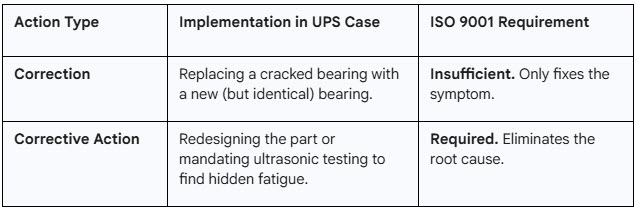
The NTSB found that even when Boeing recommended a redesigned part, they still allowed operators to replace failed bearings with the older, failure-prone design.8 A true Root Cause Analysis would have identified metal fatigue as the culprit and made the redesigned part the only legal replacement.
The Human Cost of Quality Failure
The UPS crash claimed 15 lives—three crew members and twelve people on the ground.9 ISO 9001 is often criticized as a “paperwork exercise,” but in high-stakes industries like aerospace, the “paperwork” is actually a rigorous logic of survival.
By failing to treat known part failures with the gravity required by risk-based thinking, the system allowed a known hazard to remain in the sky until it reached its breaking point.
About The Author
Oscar Combs is the President of ISO Certifications Group, a certification body headquartered in Houston, Texas. With over 31 years of experience in the field, he is recognized as an expert in management systems that help organizations manage risk and improve operational efficiency.
ISO Certifications Group
ISO Certifications Group is an accredited ISO certification body that certifies ISO 9001, ISO 14001, ISO 45001 and ISO 50001 Management Systems for organizations. Contact us at info@isocertificationsgroup.com for more information or www.isocertificationsgroup.com.info@isocertificationsgroup.com for more information or www.isocertificationsgroup.com.
Watch our YouTube Video about this article.